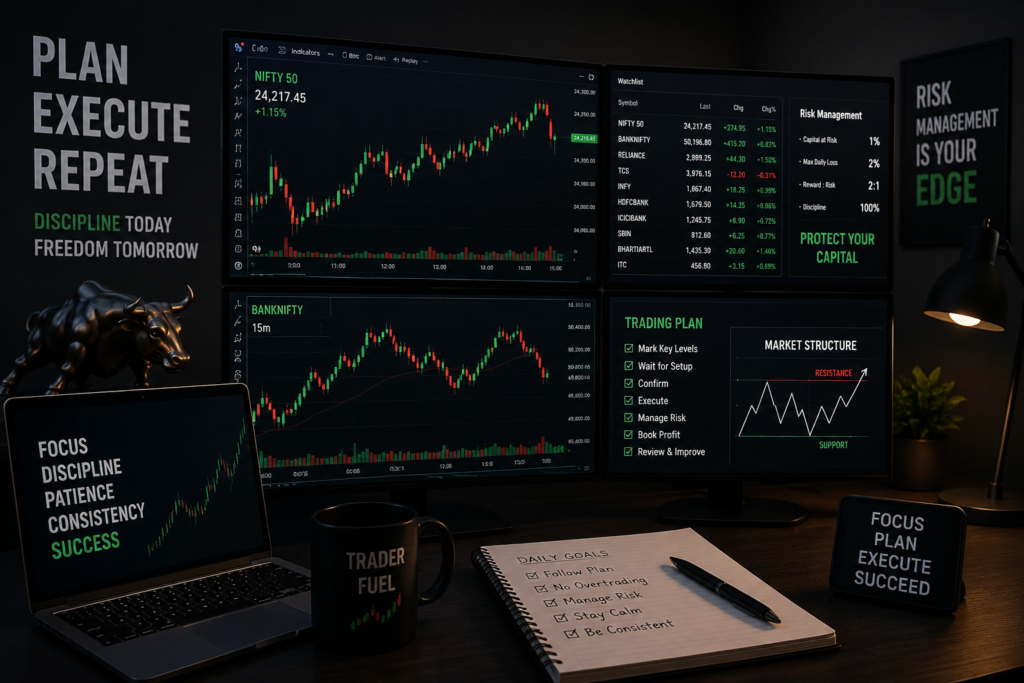
Trading Classes Near Me
Learn. Practice. Analyze. Trade with Confidence.
Meta Title: Trading Course Near Me | Learn Trading Basics
Meta Description: Find a Trading Course Near Me that teaches market basics, technical analysis, risk management and practical trading skills for beginners.
Slug: trading-course-near-me

Introduction
Searching for Trading Course Near Me usually means you want more than random videos and social media tips. You want someone to explain charts clearly, answer your questions and help you understand how real market decisions are made.
For beginners between 18 and 25, joining the right trading class can make the learning process much easier. A good course should teach you how markets work, how to read candlesticks, identify support and resistance, understand trends and manage risk before you think about making profits.
The important point is simple: trading is a skill that takes practice. There is no guaranteed income, and capital loss is always possible.
Table of Contents
- Why Consider Trading Classes Near Me?
- What Should a Trading Course Teach?
- How to Choose the Best Trading Course Near Me
- Common Mistakes Beginners Make
- A Simple Learning Approach
- Frequently Asked Questions
- Conclusion
Why Consider Trading Classes Near Me?
Learning trading in a classroom or structured local environment can be useful when you are starting from zero. You can ask questions immediately instead of spending hours trying to understand confusing explanations online.
A practical trading class may help you learn:
- Stock market basics
- Candlestick patterns
- Support and resistance
- Trendlines and chart patterns
- Technical analysis
- Fundamental analysis
- Risk management
- Trading psychology
For example, imagine a beginner sees a stock moving upward quickly. Without proper knowledge, they may enter simply because the price is rising. A trained trader would first look at the trend, important price levels, volume and possible risk.
That difference comes from understanding, not guessing.
What Should a Trading Course Teach?
Market Fundamentals
Start with the basics. You should understand stocks, indices, exchanges, orders, trading sessions and basic market terminology before moving toward advanced strategies.
Technical Analysis
Technical analysis helps traders study price movement through charts. A beginner should become comfortable with:
- Candlestick patterns
- Support and resistance
- Trendlines
- Chart patterns
- Moving averages
- Volume
- Basic indicators
The goal is not to use every indicator available. It is to understand why a particular tool is being used.
Risk Management
This is one of the most important parts of trading education.
A simple example is risking a small, predefined amount on each trade rather than putting a large part of your capital into one idea. Stop loss planning, position sizing and risk to reward thinking can help control losses.
No strategy can remove trading risk completely.
Trading Psychology
Even a good strategy can fail if emotions control your decisions. Fear can make you exit too early, while greed can make you hold a losing trade for too long.
Good education should teach discipline alongside technical skills.
How to Choose the Best Trading Course Near Me
When comparing the Best Trading Course Near Me, do not choose only because a course has an attractive advertisement or impressive profit claims.
Look for these practical points:
| Factor | What to Check |
|---|---|
| Curriculum | Covers basics before advanced topics |
| Trainer | Has practical market knowledge |
| Practice | Includes chart analysis and examples |
| Risk Management | Clearly explained |
| Doubt Support | Questions can be discussed |
| Transparency | No guaranteed profit claims |
A useful question to ask before joining is: Will I actually learn how to analyze a trade, or will I only receive ready made calls?
Learning analysis is more valuable for long term development.
Common Mistakes Beginners Make
Many new traders make similar mistakes.
- Starting with real money too quickly
- Following random tips
- Using excessive leverage
- Ignoring stop loss planning
- Changing strategies after a few losses
- Expecting fast income
- Trading without maintaining a record
Keeping a simple trading journal can help. Record the reason for entering, the planned risk, the result and what you learned. After several trades, patterns in your decision making become easier to notice.
A Simple Learning Approach
If you are completely new, follow a gradual process.
Step 1: Learn market fundamentals.
Step 2: Study candlesticks, trends and price levels.
Step 3: Practice chart analysis without risking money.
Step 4: Learn risk management and position sizing.
Step 5: Develop and test one simple trading setup.
Step 6: Maintain a trading journal.
Step 7: Review your decisions regularly.
This approach is slower than searching for instant tips, but it builds a stronger foundation.
Frequently Asked Questions
What is a Trading Course Near Me?
It is a local or nearby educational program that teaches stock market and trading concepts through structured lessons, examples and practice.
Is trading suitable for beginners?
Yes, beginners can learn trading, but they should start with education and practice. Trading involves risk, and losses can occur.
How long does it take to learn trading?
Basic concepts can be learned relatively quickly, but developing consistent analysis and discipline takes regular practice and experience.
What should I learn first in trading?
Start with market fundamentals, candlestick basics, support and resistance, trends and risk management.
How do I find the Best Trading Course Near Me?
Compare the curriculum, trainer experience, practical learning, risk management education, student support and transparency before making a decision.
Conclusion
Finding the right Trading Course Near Me can give beginners a structured way to understand financial markets. However, the quality of the learning matters more than simply joining a nearby class.
Focus on education that teaches you how to analyze charts, understand market behavior and manage risk. Most importantly, remember that trading does not guarantee profits. Capital can be lost, so responsible decision making should always come before the desire for quick returns.
CTA
If you are planning to learn trading, start by comparing courses carefully, checking what they teach and choosing an option that focuses on knowledge, practice and responsible risk management.