
Basic Share Market Course: A Simple Guide to Confident Investing
Learn the Basics of the Stock Market and Build Practical Trading & Investing Skills

Introduction
Starting the stock market can feel confusing when you see charts, company names, market news, technical indicators, and unfamiliar financial terms everywhere. The good news is that you do not need to understand everything on day one.
A basic share market course can help you build the right foundation before you put your money at risk. Instead of randomly following social media tips or buying a stock because someone says it will rise, you can learn how the market works, how shares are bought and sold, and how to evaluate risk.
For someone between 18 and 25, learning these concepts early can be especially useful. You have time to develop financial knowledge, make mistakes with small amounts, and build better habits before taking larger decisions.
This guide explains the essential share market basics in simple language and shows what a beginner should actually learn.
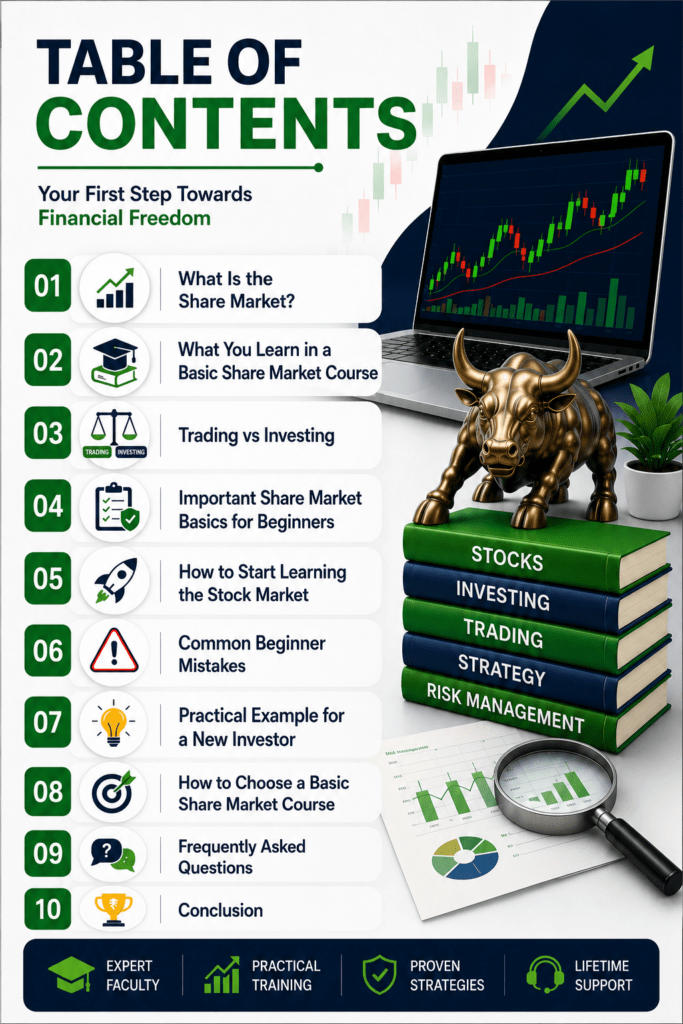
Table of Contents
- What is the Share Market?
- What you learn in a basic Share Market Course
Trading vs Investing
Important Share Market Basic for Beginners
How to Start Learning the Stock Market
Common Beginner Mistake
Pratial Example for a New Investor
HOw to Choose a Basic Share Market Course
Frequently Asked Question
Conclusion
What Is the Share Market?
The share market is a marketplace where investors can buy and sell shares of publicly listed companies. When you purchase a share, you own a small portion of that company.
For example, imagine a company has 10 million shares and you purchase 100 shares. Your ownership is very small, but you still become a shareholder.
In India, investors commonly interact with stock exchanges such as NSE and BSE through registered intermediaries. NSE also provides educational resources covering account opening, buying and selling shares, investor protection, and other market concepts.
The price of a share can move because of many factors, including company performance, earnings, economic conditions, interest rates, investor expectations, industry developments, and market sentiment.
That is why simply seeing a stock price rise does not automatically mean it is a good investment.
- Beginners ke liye Basic Share Market Course stock market terminology aur trading concepts ko simple way mein samajhne ka useful option hai.
- Sahi Basic Share Market Course choose karte waqt course content, practical learning aur instructor guidance ko consider karna chahiye.
- Ek well-structured Basic Share Market Course aapko stock market mein informed decisions lene ke fundamentals develop karne mein help kar sakta hai.
What You Learn in a Basic Share Market Course
A good beginner course should focus on understanding before strategy.
1. Stock Market Fundamentals
You should first understand terms such as:
- Shares
- Stocks
- Equity
- Stock exchanges
- Market capitalization
- Dividends
- IPO
- Bull market
- Bear market
- Demat account
- Trading account
These terms form the language of the market. Without understanding them, financial news and research reports can become difficult to follow.
2. Demat and Trading Accounts
A beginner should understand the difference between a demat account and a trading account.
A demat account holds securities electronically, while a trading account is used to place buy and sell orders. SEBI educational material also explains the importance of having appropriate banking, trading, and demat arrangements when investing in securities.
Before opening an account, beginners should also verify that they are dealing with an authorised intermediary.
3. Fundamental Analysis
Fundamental analysis focuses on understanding a company’s business and financial condition.
You may learn how to examine:
- Revenue
- Profit
- Debt
- Earnings
- Cash flow
- Return ratios
- Business model
- Competitive position
For example, suppose two companies operate in the same industry. Company A has growing revenue, manageable debt, and improving profits. Company B has declining sales and increasing debt.
The share price alone does not tell you which company has stronger fundamentals. You need to investigate the underlying business.
4. Technical Analysis
Technical analysis studies price and volume data to identify possible market patterns.
Beginners may encounter concepts such as:
- Support
- Resistance
- Trend
- Moving averages
- Candlestick patterns
- Volume
- Breakouts
Technical analysis can be useful for understanding price behaviour, but it should not be treated as a guaranteed prediction system.
A chart shows what has happened in the market. It does not guarantee what will happen next.
Trading vs Investing
One of the first decisions a beginner needs to understand is the difference between trading and investing.
Investing generally focuses on holding an asset for a longer period based on expectations about the underlying business or investment.
Trading usually involves taking positions over shorter periods with the aim of benefiting from price movements.
Consider a simple example.
Rahul studies a company and believes its business could grow substantially over the next five years. He purchases shares and plans to hold them while monitoring the company’s performance. This is closer to investing.
Another person purchases a stock because its price has broken above a particular resistance level and plans to exit if the expected movement occurs. This is closer to trading.
Neither approach is automatically better. The important point is understanding the difference and choosing an approach that matches your knowledge, financial goals, time availability, and risk tolerance.
NSE educational material also separates long term investing from short term trading when introducing beginners to the capital market.
- Agar aap trading shuru karna chahte hain, to Basic Share Market Course se apni learning journey start kar sakte hain.
- A practical Basic Share Market Course mein market analysis aur risk management jaise important topics bhi cover kiye ja sakte hain
Important Share Market Basics for Beginners
Learning terminology is only the beginning. You also need to understand how decisions are made.
Risk and Return
Higher potential returns generally come with higher uncertainty. A stock can increase significantly, but it can also fall sharply.
Never assume that a high return is guaranteed.
A useful beginner habit is to ask three questions before making an investment:
- What am I buying?
- Why am I buying it?
- What could make this decision wrong?
These questions sound simple, but they can prevent many emotional decisions.
Diversification
Putting all your money into one company creates concentration risk.
For example, if a beginner invests their entire savings into one stock and that company experiences serious problems, the entire portfolio can be affected.
Diversification can help reduce the impact of a poor performance from one investment. However, diversification does not eliminate market risk.
Compounding and Time
Young investors often have one important advantage: time.
Starting early does not mean taking unnecessary risks. It means having more years to learn, invest consistently, and potentially benefit from compounding.
NSE’s investor education material highlights investing early, investing regularly, and taking a long term approach as important principles for wealth creation.
How to Start Learning the Stock Market
You do not need to begin with complicated derivatives or advanced trading strategies.
A practical learning sequence is:
- Understand stock market terminology.
- Learn how exchanges and brokers work.
- Understand demat and trading accounts.
- Learn basic fundamental analysis.
- Study basic technical analysis.
- Learn risk management.
- Practise reading company information.
- Track a small watchlist.
- Record your reasons for every decision.
- Gradually develop your own process.
One useful exercise is to create a virtual portfolio before investing real money. Pick five companies, write down why you selected them, and track their performance for several weeks.
This will teach you something that textbooks cannot fully provide: how your own emotions react when prices move.
NSE currently provides beginner focused investor education material and structured learning modules for people who want to understand securities markets.
How to Choose a Basic Share Market Course
Not every course is equally useful.
Before enrolling, check whether the curriculum covers the fundamentals instead of focusing mainly on profit claims.
Look for:
- Stock market terminology
- Fundamental analysis
- Technical analysis
- Trading and investing concepts
- Risk management
- Portfolio basics
- Practical examples
- Market structure
- Investor protection
- Realistic expectations
Also check who is teaching the course and whether the educational material is transparent.
A strong course should not promise guaranteed returns or present trading as an effortless way to become wealthy.
For additional independent learning, the NSE provides investor education resources and beginner courses, while SEBI provides financial education material for investors.
You can also explore your site’s related resources such as Trading Course Fees and Trading Classes to compare learning options and understand what different programs may cover.
Practical Example for a New Investor
Suppose a 20 year old student has started earning from a part time job.
Instead of immediately investing a large amount, the student spends the first month learning stock market terminology and account mechanics.
During the next month, they study three companies from different industries.
They compare revenue growth, profitability, debt, business models, and recent company developments.
They then create a small watchlist and track the companies without immediately buying them.
After several weeks, they understand how prices move and notice that their original assumptions were not always correct.
That experience is valuable.
The goal of beginner education is not to produce someone who predicts every price movement. It is to develop someone who can make a decision, understand the risks, review the outcome, and improve the process.
| Course Type | Learning Focus | Typical Duration | Fee Range |
|---|---|---|---|
| Basic Trading Course | Stock market fundamentals, shares, charts, and order types | 1 to 4 Weeks | ₹2,000 to ₹10,000 |
| Technical Analysis Course | Candlesticks, trends, support, resistance, indicators, and price action | 2 to 8 Weeks | ₹5,000 to ₹20,000 |
| Intraday Trading Course | Price action, volume analysis, entry, exit, and trade management | 2 to 8 Weeks | ₹8,000 to ₹30,000 |
| Swing Trading Course | Trend analysis, chart patterns, trade planning, and risk management | 2 to 8 Weeks | ₹8,000 to ₹25,000 |
| Options Trading Course | Calls, puts, option strategies, Greeks, and risk concepts | 4 to 12 Weeks | ₹10,000 to ₹50,000 |
| Advanced Trading Program | Advanced strategies, trading psychology, risk management, and mentorship | 1 to 6 Months | ₹25,000 to ₹1,00,000+ |
Common Beginner Mistakes
Many new investors make similar mistakes.
Following Social Media Tips
A person posting a profitable trade online does not automatically mean the same trade is suitable for you.
NSE specifically warns investors about unsolicited stock tips, fake trading scams, and misleading financial influencers.
Expecting Quick Money
The stock market is not a guaranteed income machine.
If your main reason for learning trading is to make quick money, you may take excessive risk. Education should come before expectations.
Investing Without Research
Buying a company because its share price looks cheap is not enough.
A stock trading at a low price may still be expensive relative to its earnings or business prospects.
Ignoring Risk Management
Even a well researched trade can go wrong.
Beginners should understand position sizing, risk limits, diversification, and the importance of protecting their available capital.
Trying Advanced Strategies Too Early
Options, futures, leverage, and complex trading systems can introduce significant additional risk.
A sensible learning path starts with share market basics before moving toward advanced products.
FAQ's
Find ansswers to commonly asked questions about our services and trading strategie
What is a basic share market course?
A basic share market course is a beginner level learning program that explains stock market fundamentals, investing, trading, market terminology, analysis, and risk management.
Is a basic share market course suitable for beginners?
Yes. A beginner course can be useful if you have little or no previous knowledge of stocks, investing, or trading. Start with basic concepts before moving toward advanced strategies.
What are the most important share market basics to learn?
Start with shares, stock exchanges, demat accounts, trading accounts, market orders, investing, trading, risk, diversification, fundamental analysis, and basic technical analysis.
Can I learn stock market trading without a course?
Yes. There are many educational resources available online. However, a well structured course can make the learning process easier by arranging concepts in a logical sequence.
How much money should a beginner invest?
There is no universal amount that is suitable for everyone. Your investment should depend on your financial situation, goals, emergency savings, and ability to tolerate losses. Do not invest money you cannot afford to lose.
Conclusion
A basic share market course should do more than teach you how to place a buy or sell order. It should help you understand why markets move, how companies are evaluated, how risk works, and how to make decisions without depending entirely on someone else’s opinion.
The most important part of learning is not finding a perfect stock. It is developing a repeatable process.
Start with share market basics, practise with examples, study real companies, maintain realistic expectations, and increase your knowledge before increasing your financial exposure.
For a young beginner, the biggest advantage is not having a large amount of money. It is having enough time to learn properly and build disciplined financial habits
- A Basic Share Market Course beginners ko stock market ke fundamental concepts samajhne mein help karta hai.
- Ek Basic Share Market Course ke through students stocks, shares aur market movements ko samajhna seekhte hain.