
Trading Classes to Build Better Trading Skills
Learn Practical Trading Skills with Market Analysis and Risk Management

Introduction
Learning to trade can look simple when you watch someone buy a stock and later sell it at a profit. The difficult part is understanding why a trade was taken, how much risk was involved, and what to do when the market moves in the opposite direction.
This is where Trading Classes can provide a structured starting point. Good classes do more than explain candlestick patterns or popular indicators. They help beginners understand market behaviour, analyse price movements, manage risk, and build discipline.
For students and young professionals between 18 and 25, proper stock market training can reduce the confusion that often comes from random videos, social media tips, and untested strategies. The goal should not be to find a shortcut to quick profits. The goal is to develop skills that can help you make more informed trading decisions.
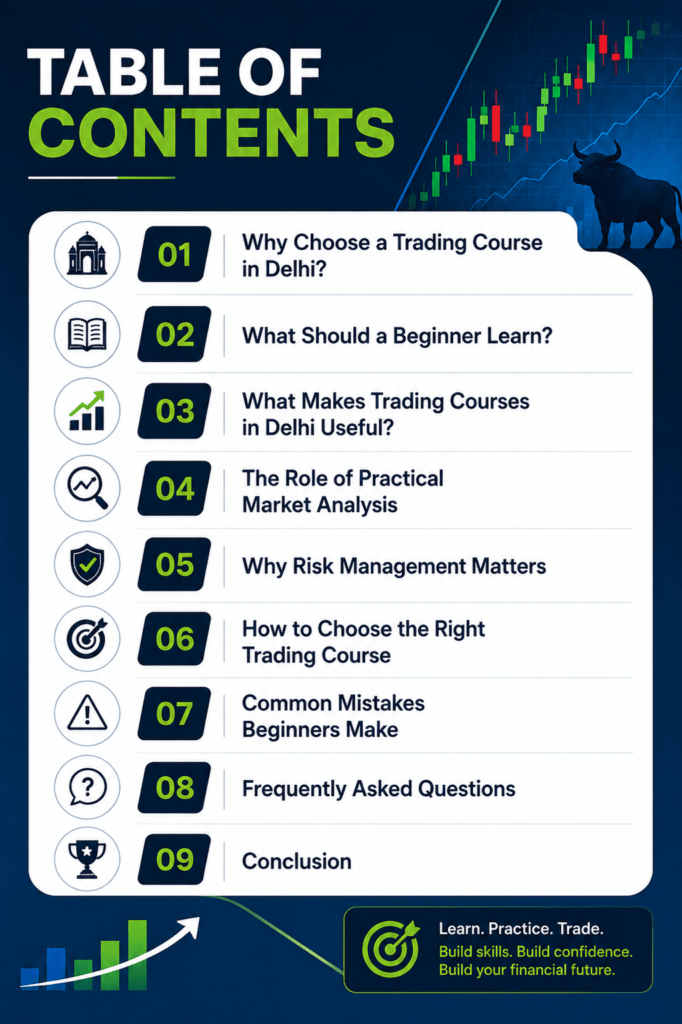
Table of Contents
- What Are Trading Classes?
- What You Can Learn From Trading Classes
- Why Practical Stock Market Training Matters
- A Simple Example of a Trading Decision
- How to Choose the Right Trading Classes
- Common Mistakes Beginners Should Avoid
- Frequently Asked Questions
- Conclusion
What Are Trading Classes?
Trading Classes are structured learning programs designed to teach people how financial markets work and how traders make decisions.
Depending on the course, students may learn about:
- Stock market basics
- Technical analysis
- Fundamental analysis
- Candlestick patterns
- Support and resistance
- Price action
- Trading strategies
- Position sizing
- Stop loss planning
- Risk management
- Trading psychology
A useful learning program should explain both theory and practical application. Knowing the definition of support and resistance is helpful, but understanding when that information matters during a real market situation is far more valuable.
Trading Is a Skill, Not Just Information
Many beginners spend weeks watching videos and collecting strategies. However, information alone does not automatically create skill.
Consider someone who learns five different trading strategies but has never tested any of them. That person may still struggle when real money is involved.
A structured approach can help you move through a clearer process:
- Learn the concept.
- Understand when it can be applied.
- Study historical examples.
- Practise using charts.
- Define risk before entering a trade.
- Review the outcome.
This process is one reason why practical stock market training can be more useful than simply memorising trading terminology.
What Can You Learn From Trading Classes?
1. Understanding How the Market Moves
Price movements are influenced by buyers, sellers, news, economic conditions, company performance, and market sentiment.
A beginner does not need to predict every movement. Instead, they should learn how to read market structure and identify situations where the potential risk and reward make sense.
For example, a trader may notice that a stock repeatedly finds buying interest near a particular price level. This does not guarantee that the price will rise again. However, it can provide a level for further analysis.
2. Technical Analysis
Technical analysis involves studying price charts and market behaviour.
Some common areas include:
- Trend identification
- Support and resistance zones
- Volume analysis
- Chart patterns
- Moving averages
- Relative strength indicators
- Candlestick behaviour
The important lesson is that an indicator should not be treated as a guaranteed signal. It is simply one piece of information.
A practical trader asks, “What does the overall market structure suggest?” rather than blindly following a single indicator.
3. Risk Management
Risk management is one of the most important subjects covered in quality Trading Classes.
Imagine two beginners. Both make five trades.
The first trader risks 20 percent of their capital on every trade. The second trader follows a predefined risk limit and uses position sizing.
Even if both traders have the same number of winning trades, their long term results can be very different.
A proper risk management approach may include:
- Deciding the maximum acceptable loss
- Using an appropriate stop loss
- Calculating position size
- Avoiding excessive exposure
- Not risking money needed for essential expenses
A strategy without risk control can become dangerous, especially during volatile market conditions.
Why Practical Stock Market Training Matters
The difference between reading about trading and actually practising it is significant.
Suppose you learn about a breakout strategy. On paper, the idea may appear simple. Buy when the price moves above resistance and sell according to your plan.
In a real market, several questions appear:
- Is the breakout supported by volume?
- Is the broader market moving in the same direction?
- Where should the stop loss be placed?
- How much capital should be used?
- What happens if the breakout fails?
Practical stock market training teaches students to think through these questions before entering a position.
Imagine Rahul notices that a stock is rising quickly. He enters the trade because he is afraid of missing the opportunity.
The price falls shortly after his entry.
Because Rahul has no stop loss or exit plan, he keeps holding the position and hoping for a recovery.
Now consider a second trader. Before entering, she defines:
- Entry level
- Stop loss level
- Target or exit plan
- Amount of capital to risk
The second trader may still lose money on that trade. However, the loss is planned and controlled.
That is an important distinction. Good trading is not about winning every time. It is about managing decisions and protecting capital.
How to Choose the Right Trading Classes
Not every course will suit every learner. Before joining a program, consider the following factors.
Check the Course Structure
A clear program should move from basic concepts to more advanced topics.
For a beginner, a sensible learning path may include:
- Understanding financial markets.
- Learning how stocks and other instruments work.
- Reading price charts.
- Understanding technical and fundamental analysis.
- Learning trading strategies.
- Practising risk management.
- Reviewing trades and improving discipline.
A course that jumps directly into “secret strategies” without teaching the basics may not provide a strong foundation.
Look for Practical Examples
Ask whether the program includes chart analysis, case studies, examples of winning and losing trades, and opportunities to understand real market situations.
Seeing only successful examples can create unrealistic expectations. Educational programs should also explain failed trades and why they failed.
Understand the Instructor’s Teaching Approach
A good instructor should explain concepts clearly instead of relying only on complicated terminology.
You should also be cautious about anyone promising guaranteed returns. Financial markets involve risk, and no legitimate educational approach can guarantee profits.
Compare Before Enrolling
Before choosing a program, compare:
- Course curriculum
- Practical learning opportunities
- Beginner suitability
- Risk management coverage
- Teaching method
- Student support
- Course duration
You can also explore educational resources from organizations such as NSE India and SEBI Investor Education to strengthen your understanding of market basics.
For further learning, you can also explore your internal guides on Trading Course Fees and Basic Share Market Course.
Common Mistakes Beginners Should Avoid
Following Random Tips
Social media can introduce you to market ideas, but a tip without proper research is not a trading plan.
Always understand why you are entering a trade and what conditions would prove your idea wrong.
Using Too Much Capital Too Early
Beginners sometimes believe that larger positions will help them earn faster. The opposite can also happen. A large loss can damage both capital and confidence.
Start with learning and controlled risk.
Changing Strategies Too Frequently
A trader may use one strategy on Monday, another on Wednesday, and a completely different approach the following week.
This makes it difficult to understand what actually works.
Give a method enough time to study and test it properly.
Ignoring Trading Psychology
Fear, greed, frustration, and overconfidence can influence decisions.
A useful habit is maintaining a trading journal. Record:
- Why you entered
- Your entry price
- Risk level
- Exit reason
- What you learned
Over time, this record can reveal repeated mistakes and patterns in your decision making.
| Learning Module | Topics Covered | Practical Skills | Suitable For |
|---|---|---|---|
| Stock Market Basics | Shares, stock exchanges, indices, order types, and market participants | Understanding how the stock market works | Complete beginners |
| Technical Analysis | Candlesticks, trends, support, resistance, indicators, and price action | Reading charts and identifying market conditions | Beginners and intermediate learners |
| Trading Strategies | Intraday, swing, and positional trading concepts | Creating structured trading plans | Active learners |
| Risk Management | Position sizing, stop loss planning, risk reward, and capital management | Managing potential losses before entering trades | All learners |
| Trading Psychology | Discipline, patience, emotional control, and decision making | Developing consistent trading habits | Beginners and active traders |
| Market Practice | Chart analysis, trade planning, and performance review | Applying trading concepts to market scenarios | Intermediate learners |
Best Practices for Beginners
If you are starting with Trading Classes, focus on building a process rather than chasing quick results.
- Learn the basics before using advanced strategies.
- Practise chart analysis regularly.
- Understand risk before placing a trade.
- Keep a trading journal.
- Review losing trades without emotional reactions.
- Avoid borrowing money for speculative trading.
- Test strategies before risking significant capital.
- Continue learning about market behaviour.
One of the most useful lessons for a new trader is simple: protecting capital gives you more opportunities to learn.
FAQ's
Find ansswers to commonly asked questions about our services and trading strategie
1. What are Trading Classes?
Trading Classes are educational programs that teach market concepts, trading strategies, chart analysis, risk management, and trading psychology.
2. Are Trading Classes suitable for beginners?
Yes. Beginner friendly classes can help students understand market basics before moving towards technical analysis and trading strategies.
3. What should I learn first in stock market training?
Start with how financial markets work, basic terminology, price charts, risk management, and simple market analysis.
4. How long does it take to learn trading?
The learning period depends on the individual. Understanding the basics may take weeks or months, while developing consistency and practical decision making usually requires continuous practice.
5. Can Trading Classes guarantee profits?
No. Trading involves market risk, and no course or instructor can guarantee profits. A good program should focus on education, analysis, risk control, and realistic expectations.
Conclusion
Trading Classes can provide a useful structure for beginners who want to understand markets in a more organised way. The real value comes from learning how to analyse situations, manage risk, and make decisions based on a clear process.
The most effective stock market training does not promise instant success. Instead, it teaches skills that can be practised, reviewed, and improved over time.
If you are between 18 and 25 and interested in learning trading, begin with the fundamentals. Study the markets, practise with examples, understand risk, and develop patience before expecting results.