
Learn Trading: 7 Proven Tips for Successful Trading
Learn Trading Skills with Practical Market Analysis and Risk Management
Learn Trading
Many young people become interested in the stock market after seeing traders share profits, charts, and market opportunities online. However, trading is not simply about buying a stock and hoping its price increases. If you want to learn trading, you need to understand how markets work, how to read price movements, and most importantly, how to manage risk.
Good trading skills develop through education, observation, practice, and discipline. For beginners between 18 and 25, starting with proper Stock Market Education can help create a stronger foundation before risking real money.
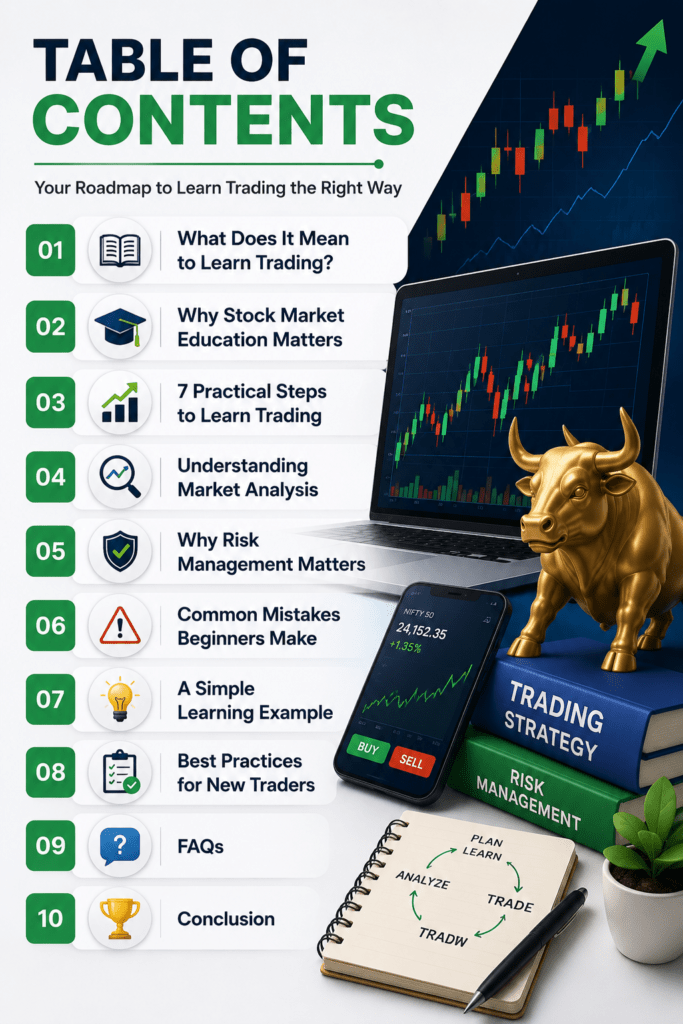
Table of Contents
What Does It Mean to Learn Trading?
Why Stock Market Education Matters
7 Practical Steps to Learn Trading
Understanding Market Analysis
Why Risk Management Matters
Common Mistakes Beginners Make
A Simple Learning Example
Best Practices for New Traders
Frequently Asked Questions
Conclusion
What Does It Mean to Learn Trading?
Trading means buying and selling financial instruments with the aim of benefiting from price movements. Depending on the market and strategy, a trader may hold a position for minutes, hours, days, or longer.
When you learn trading properly, you study more than entry and exit points. You also understand:
- How financial markets operate
- Why prices move
- How buyers and sellers affect demand
- How charts can be analysed
- How different trading strategies work
- How to control potential losses
- How emotions can affect decisions
A beginner who only focuses on finding profitable trades often misses the most important part of the learning process. Trading is largely about making informed decisions while accepting that losses are part of the process.
Why Stock Market Education Matters Before You Start
Proper Stock Market Education helps beginners understand the difference between knowledge and speculation.
For example, imagine two beginners. The first person follows random social media tips and enters trades without understanding the reason behind them. The second person spends time learning charts, market behaviour, position sizing, and risk management.
The second person may not become profitable immediately, but they have a clearer process for analysing their decisions.
This is why education should come before aggressive trading.
A useful learning foundation can include:
- Market basics
- Types of financial instruments
- Technical analysis basics
- Fundamental factors
- Support and resistance
- Trend analysis
- Risk management
- Trading psychology
Learning these concepts gives beginners a framework instead of depending completely on tips or predictions.
7 Practical Steps to Learn Trading
1. Understand the Basics of the Stock Market
Start by learning what stocks, indices, exchanges, orders, and market participants are.
You should understand basic terms such as:
- Market order
- Limit order
- Stop loss
- Volume
- Volatility
- Liquidity
- Position size
Do not rush through these concepts. A strong foundation makes advanced topics easier to understand later.
2. Choose One Market to Study First
Beginners often make the mistake of trying to trade everything at once.
You may see stocks, indices, commodities, currencies, and other instruments. Instead of learning all of them together, focus on one area initially.
This makes it easier to observe price behaviour and understand how that market moves.
3. Learn Basic Chart Analysis
Charts help traders study historical price movements. However, indicators and patterns should not be treated as guaranteed prediction tools.
Start with simple concepts:
- Price trends
- Support and resistance
- Trading volume
- Market structure
- Basic candlestick behaviour
For example, if a stock repeatedly struggles to move above a particular price level, that area may become important for future analysis. The goal is not to predict every movement perfectly. The goal is to create a logical trading plan.
4. Practice Before Taking Large Risks
A beginner can learn a great deal by observing the market and maintaining a trading journal.
Before risking significant capital, practice analysing possible trades.
Record:
- Why you considered the trade
- Your entry idea
- Your expected exit
- Your risk level
- What actually happened
Over time, this journal can reveal patterns in your own decision making.
5. Learn Risk Management Early
Risk management should not be treated as an advanced topic. It is one of the first concepts a new trader should understand.
A trader may have a good strategy and still face losses if they take positions that are too large.
Before entering a trade, consider:
- How much money could be lost?
- Where would the trade idea become invalid?
- Is the position size reasonable?
- Does the potential risk fit your plan?
This habit can help prevent one poor decision from having an unnecessarily large impact on your capital.
6. Understand Trading Psychology
Trading involves emotions. Fear may cause someone to exit too early, while greed may encourage them to hold a position longer than planned.
A common beginner experience looks like this:
A trade moves slightly into profit. The trader becomes excited and changes the original plan. Later, the price reverses, and the trader makes a rushed decision.
The lesson is simple. A trading plan is more useful when it is created before emotions become involved.
7. Keep Learning From Your Results
Markets change, and no strategy works perfectly in every situation.
After each trade or practice session, review what happened.
Ask yourself:
- Did I follow my plan?
- Was my analysis logical?
- Did I manage risk correctly?
- Did emotions affect my decision?
- What can I improve next time?
This process turns every result into a learning opportunity.
Understanding Market Analysis When You Learn Trading
Market analysis generally involves studying information that may influence price movements.
Technical analysis focuses on price, volume, trends, and chart behaviour.
Fundamental analysis focuses on factors that may affect the underlying value or outlook of an asset.
For a beginner, it is useful to understand both approaches. You do not need to master every technique immediately. Start with the basics and gradually build your knowledge.
Reliable financial information can also be found through recognised regulatory and educational resources such as the Securities and Exchange Board of India.
Why Risk Management Is More Important Than Finding Perfect Trades
One important lesson in trading is that no analysis method can guarantee a profitable outcome.
Even a carefully planned trade can result in a loss.
For this reason, risk management focuses on controlling the amount you may lose rather than assuming every trade will work.
A simple approach includes:
- Deciding your maximum acceptable risk
- Using a planned exit level when appropriate
- Avoiding oversized positions
- Not chasing losses
- Keeping enough capital for future opportunities
Experienced traders often focus heavily on survival and consistency. Protecting capital allows you to continue learning and participating in the market.
Common Mistakes Beginners Make
When people first learn trading, some mistakes appear repeatedly.
Following Tips Without Understanding Them
A trade idea may work once and fail the next time. If you do not understand why you entered, you cannot properly evaluate the result.
Taking Excessive Risk
Trying to recover losses quickly can lead to larger mistakes. Risk should remain controlled even after a losing trade.
Using Too Many Indicators
Adding multiple indicators to a chart does not automatically improve analysis. Beginners often benefit from understanding price behaviour before adding complex tools.
Ignoring a Trading Plan
Entering a trade without a clear reason can turn the process into guesswork.
| Learning Stage | What You Learn | Practical Skills | Main Focus |
|---|---|---|---|
| Stock Market Basics | Shares, stock exchanges, indices, Demat accounts, and order types | Understanding how the stock market works | Build a strong foundation |
| Chart Reading | Candlesticks, price trends, support, and resistance | Reading and analysing price charts | Understand market movement |
| Technical Analysis | Indicators, price action, volume, and chart patterns | Identifying potential market setups | Improve market analysis |
| Trading Strategies | Intraday, swing, and positional trading concepts | Creating structured trading plans | Develop a systematic approach |
| Risk Management | Position sizing, stop loss planning, risk reward, and capital management | Managing potential losses | Protect trading capital |
| Trading Psychology | Discipline, patience, emotional control, and decision making | Reviewing mistakes and improving consistency | Build better trading habits |
A Simple Learning Example
Imagine Rahul, a 21 year old beginner interested in the stock market.
Instead of immediately using a large amount of money, Rahul spends his first few weeks learning market basics and observing price charts.
He then creates a simple process:
- Identify the overall trend
- Mark important price levels
- Decide where the trade idea would be wrong
- Calculate the possible risk
- Record the outcome
After reviewing several practice trades, Rahul notices that he often enters trades without waiting for confirmation. He adjusts his process and becomes more patient.
The important point is not whether every trade becomes profitable. The value comes from reviewing decisions and improving the process.
Best Practices for Building Trading Skills
If you want to develop long term trading knowledge, focus on consistency rather than shortcuts.
Consider these practical habits:
- Study regularly instead of trying to learn everything in one week
- Start with basic concepts
- Use reliable educational resources
- Practice market analysis
- Maintain a trading journal
- Learn from both winning and losing trades
- Keep risk under control
- Avoid emotional decisions
- Continue improving your process
You can also build your Stock Market Education by learning from official investor education material and reliable market resources before acting on financial information.
For readers who want to explore related topics, you can also add internal links to pages such as Trading Classes, Basic Share Market Course, or Trading Course Fees on your website.
FAQ's
Find ansswers to commonly asked questions about our services and trading strategie
Can I learn trading as a complete beginner?
Yes. Beginners can start by understanding market basics, chart analysis, trading concepts, and risk management. It is generally better to build knowledge and practice before taking significant financial risks.
How long does it take to learn trading?
The time varies from person to person. Basic concepts can be learned relatively quickly, but developing analytical skills, discipline, and experience usually requires consistent practice over time.
Is Stock Market Education important before trading?
Yes. Stock Market Education can help beginners understand market behaviour, trading risks, financial terminology, and the importance of managing capital responsibly.
What is the first thing I should learn in trading?
Start with how markets work, basic financial instruments, order types, price charts, and risk management. These concepts create a foundation for further learning.
Can I learn trading without investing a large amount of money?
Yes. Beginners can first focus on education, market observation, chart analysis, and practice. Learning does not require taking large financial risks.
Conclusion
To learn trading effectively, focus on building knowledge step by step rather than searching for instant profits. Start with market basics, understand chart analysis, practice your ideas, and give serious attention to risk management.
Strong trading skills are usually built through repetition, review, and discipline. The market can be unpredictable, but your preparation and decision making process can become more structured with time.
For young beginners, proper Stock Market Education can provide a useful foundation before making important financial decisions. Learn the concepts, observe the market carefully, review your mistakes, and improve gradually.
Start your journey to Learn Trading with the right knowledge, practical skills, disciplined strategies, and effective risk management. You can also explore our Trading Classes and Basic Share Market Course to build a stronger foundation and make smarter trading decisions.