Trading Course Fees: 7 Smart Secrets to Compare Costs
Understand Trading Course Fees, Compare Different Learning Options

Introduction
Before joining a trading program, one of the first questions most students ask is about trading course fees. The price of a course can vary depending on its duration, learning format, faculty support, practical sessions, mentorship, and course content.
For beginners, comparing prices without understanding what is included can lead to a poor decision. A low fee may offer only recorded videos, while a higher fee may include live classes, assignments, doubt solving, and practical market discussions. Understanding the complete trading course fee structure helps you compare the actual value of each option.
This guide explains what affects course costs and how students can make a sensible comparison.
- Trading seekhne se pehle Trading Education ke through important concepts, strategies aur risk management ko samajhna bhi helpful ho sakta hai.
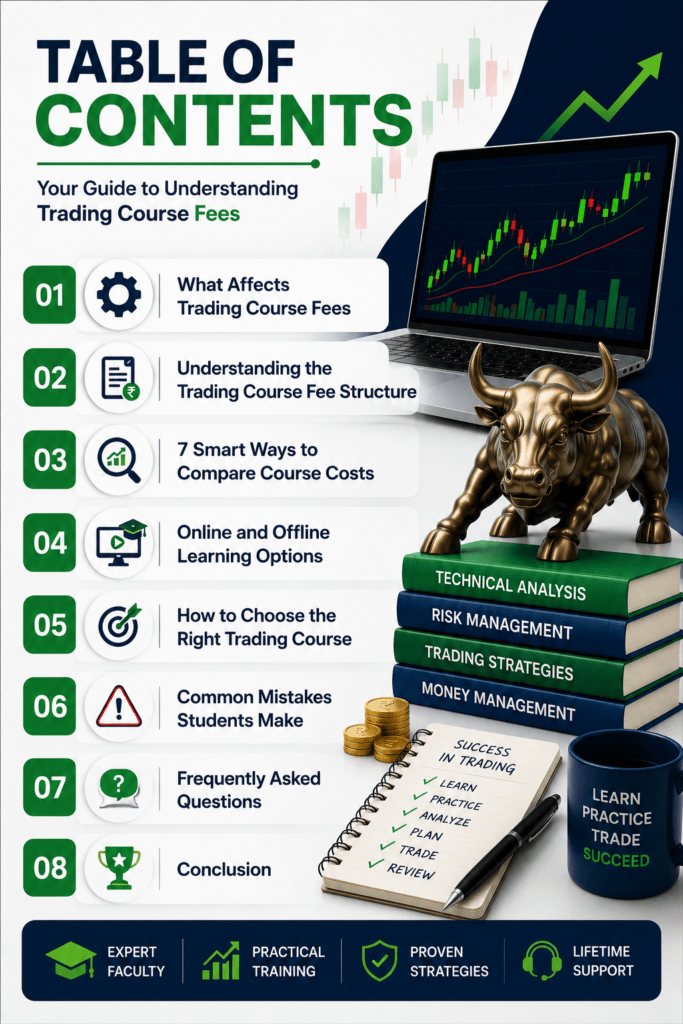
Table of Contents
- What Affects Trading Course Fees
- Understanding the Trading Course Fee Structure
- 7 Smart Ways to Compare Course Costs
- Online and Offline Learning Options
- How to Choose the Right Trading Course
- Common Mistakes Students Make
- Frequently Asked Questions
- Conclusion
- What Affects Trading Course Fees
What Affects Trading Course Fees?
Several factors influence trading course fees. Before comparing two programs, it is important to understand why their prices may be different.
Course Duration and Depth
A short introductory course generally has a different price from a detailed program that runs for several weeks or months.
However, course duration alone does not determine quality. A longer program may include unnecessary repetition, while a shorter course may provide focused and well organised learning.
Check the total teaching hours and the topics covered.
Course Curriculum
The curriculum is one of the biggest factors affecting trading course fees.
A beginner program may introduce stock market basics, trading terminology, and simple chart concepts. A more detailed program can include:
- Technical analysis
- Price action
- Support and resistance
- Risk management
- Trading psychology
- Futures and options basics
- Position sizing
- Trade planning
- Market analysis
Compare the depth of each topic instead of simply counting the number of lessons.
Practical Learning and Mentorship
Practical exercises require more involvement than recorded lessons.
For example, a student may analyse historical charts, prepare a trade plan, review market situations, and discuss mistakes with an instructor. These activities can add value because they help students understand how concepts are applied.
When reviewing trading course fees, check whether practical sessions and mentorship are included in the total price.
Understanding the Trading Course Fee Structure
A clear trading course fee structure should tell you exactly what you are paying for.
Before enrolling, check whether the total fee includes:
- Course duration
- Number of classes
- Live or recorded sessions
- Study material
- Practical assignments
- Mentorship
- Doubt solving
- Certification
- Taxes or additional charges
Transparency matters. If important costs are unclear before payment, ask for complete information.
A good comparison of trading course fees should always include the final amount you are expected to pay, not only the advertised starting price.
7 Smart Ways to Compare Trading Course Fees
1. Compare What You Actually Learn
Do not select a course simply because it has the lowest price.
Read the curriculum and check whether it matches your current level. A beginner does not always need an advanced program, and an experienced learner may find a basic course repetitive.
2. Calculate the Cost Per Learning Hour
This is a simple way to compare trading course fees.
Imagine one course costs ₹8,000 and provides 15 hours of instruction. Another costs ₹12,000 and provides 40 hours, practical assignments, and live doubt solving.
The second course costs more overall, but it may provide better value depending on the quality of the teaching.
3. Check the Complete Trading Course Fee Structure
Do not assume that every feature is included in the main price.
Some programs charge separately for advanced modules, mentorship, workshops, or certification.
Always ask for the complete trading course fee structure before making a payment.
4. Compare Learning Formats
Online programs may be suitable for students who need flexibility.
Offline classes can offer direct interaction.
Hybrid programs combine online learning with live sessions.
The right format depends on how you learn best, so compare the learning experience along with trading course fees.
5. Check Whether Practical Training Is Included
Theory is important, but practice helps students understand decision making.
A useful program may include chart analysis exercises, paper trading, historical market studies, or trade planning activities.
These exercises can make the learning experience more meaningful.
6. Review the Support Available
Some students can learn independently, while others need regular doubt solving.
Before comparing trading course fees, check whether you can ask questions after class and whether mentorship is part of the program.
7. Avoid Decisions Based Only on Marketing
An expensive course is not automatically better, and a cheap course is not automatically poor.
Look at the curriculum, teaching method, practical learning, and transparency of the trading course fee structure.
Online and Offline Trading Course Fees
Online learning is often more flexible because students can attend from different locations.
Offline learning may involve classroom facilities and direct interaction with instructors. Because of these differences, trading course fees can vary between online and offline programs.
The better option depends on your schedule, learning style, and the level of support you need.
Before choosing, ask yourself whether you learn effectively through recorded lessons or whether you benefit from live discussion and regular guidance.
Mini Case Study: Comparing Two Courses
Suppose Priya is comparing two stock market courses.
Course A costs ₹7,000 and provides recorded beginner lessons.
Course B costs ₹13,000 and includes live classes, practical chart exercises, risk management sessions, and doubt solving.
Priya should first identify her learning needs.
If she already understands the basics and prefers self paced learning, Course A may be enough. If she needs guidance and practical interaction, Course B could provide more value.
The lesson is simple. Trading course fees should be compared with the learning experience, not viewed as an isolated number.
How to Choose a Trading Course
Instead of choosing a course only because its fee looks attractive, compare the complete learning experience.
Check the Curriculum
Look at the actual topics included in the course. A detailed curriculum makes it easier to understand whether the program matches your current knowledge.
Research the Trainer
Check the trainer’s professional background, teaching experience, and publicly available educational material.
Be careful with claims that suggest guaranteed returns or effortless income.
Look for Practical Learning
Trading is a practical skill. Courses that allow students to analyse charts, build trade plans, review examples, and practise risk management can provide more useful learning than theory alone.
Compare Value, Not Just Price
Suppose Course A costs ₹5,000 and Course B costs ₹15,000. The second course is not automatically better.
If Course A provides a clear curriculum, practical assignments, experienced instruction, and useful support, it may offer better value for a beginner.
| Course Type | Learning Focus | Typical Duration | Fee Range |
|---|---|---|---|
| Basic Trading Course | Stock market fundamentals, shares, charts, and order types | 1 to 4 Weeks | ₹2,000 to ₹10,000 |
| Technical Analysis Course | Candlesticks, trends, support, resistance, indicators, and price action | 2 to 8 Weeks | ₹5,000 to ₹20,000 |
| Intraday Trading Course | Price action, volume analysis, entry, exit, and trade management | 2 to 8 Weeks | ₹8,000 to ₹30,000 |
| Swing Trading Course | Trend analysis, chart patterns, trade planning, and risk management | 2 to 8 Weeks | ₹8,000 to ₹25,000 |
| Options Trading Course | Calls, puts, option strategies, Greeks, and risk concepts | 4 to 12 Weeks | ₹10,000 to ₹50,000 |
| Advanced Trading Program | Advanced strategies, trading psychology, risk management, and mentorship | 1 to 6 Months | ₹25,000 to ₹1,00,000+ |
Common Mistakes When Comparing Trading Course Fees
Choosing the Cheapest Course Immediately
Students often have a limited budget, which is understandable. However, check whether the course covers the topics you actually want to learn.
Assuming a Higher Price Means Better Education
Price does not guarantee teaching quality.
A higher fee should be supported by a stronger curriculum, useful practical sessions, or better learning support.
Ignoring Risk Management
Any trading education should explain risk and responsible decision making.
A program that focuses only on profit opportunities gives students an incomplete picture.
Missing Additional Charges
Always confirm whether taxes, certification, advanced modules, or mentorship create additional costs beyond the advertised trading course fees.
FAQ's
Find ansswers to commonly asked questions about our services and trading strategie
What are the average trading course fees?
Trading course fees depend on the course duration, curriculum, learning format, mentorship, and practical training. Prices can vary significantly, so students should compare what is included before enrolling.
Why do trading course fees vary?
Different programs provide different levels of support. Some offer recorded lessons, while others include live classes, assignments, mentorship, or practical exercises.
What should a trading course fee structure include?
A complete trading course fee structure should clearly explain the total price, classes, duration, learning material, practical sessions, certification, and additional charges.
Are expensive trading courses always better?
No. A higher price does not automatically guarantee better teaching. Compare the curriculum and learning support before making a decision.
Are online trading courses cheaper?
Online programs may sometimes cost less because they do not require classroom facilities. However, prices depend on the instructor, content, mentorship, and other included features.
Conclusion
Understanding trading course fees can help you make a more informed decision before investing in your education. Instead of comparing only the price, review the curriculum, practical learning, mentorship, and complete trading course fee structure.
The right course should suit your current knowledge level and provide clear information about what you will receive. A thoughtful comparison can help you avoid unnecessary expenses and choose a learning option based on real educational value.