
Trading Education
Learn Trading with Practical Strategies, Market Analysis, Risk Management, and Expert Guidance

Introduction
Trading can look simple from the outside. You open a trading account, select a stock, place an order, and wait for the price to move. In reality, successful trading requires much more than knowing when to buy or sell.
Trading Education helps beginners understand how financial markets work, how to analyse price movements, how to manage risk, and how to build a disciplined trading process. For young traders, especially those exploring Trading Education in India, learning the basics before putting serious money into the market can make a major difference.
The goal is not to predict every market move. The goal is to make better decisions while understanding what can go wrong.
If you are new to the market, explore our guide on Stock Market Basics, Technical Analysis, and Risk Managementto build a stronger foundation before you start trading.
- Learn the fundamentals through our Basic Share Market Course.
- Improve your market knowledge with our Trading Classes.
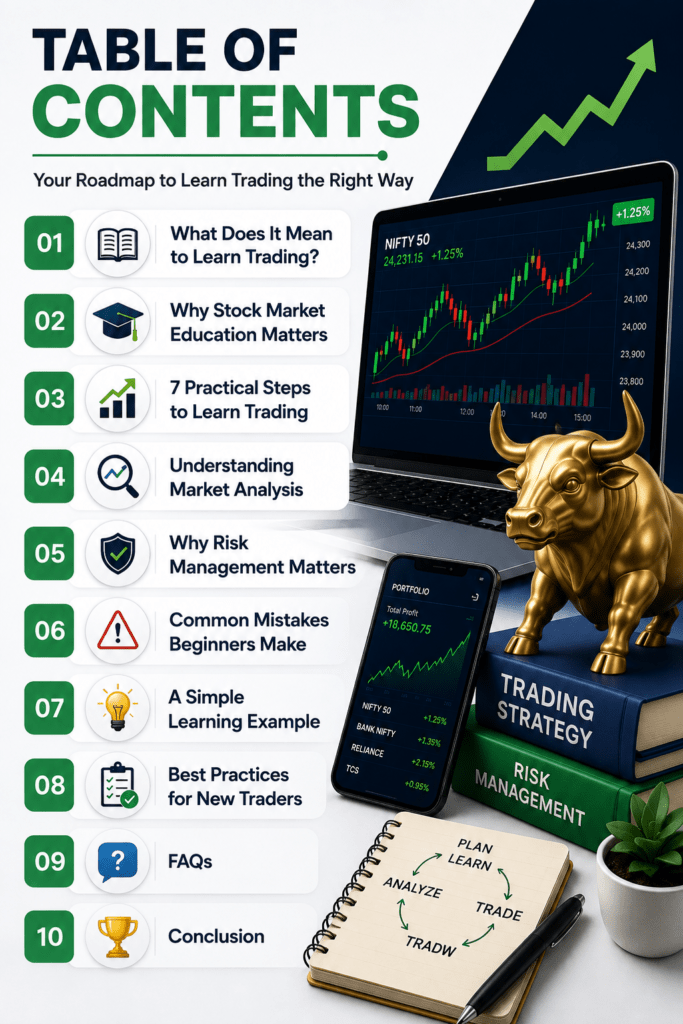
Table of Contents
- What Is Trading Education?
- Why Beginners Need Powerful Trading Education
- 7 Essential Skills Every Beginner Should Learn
- Practical Trading Strategies for Beginners: What to Know
- The Importance of Smart Risk Management
- Common Mistakes New Traders Make
- How to Start Learning Trading Successfully
- Trading Education in India: A Beginner’s Guide
- Frequently Asked Questions
- Conclusion
What Is Trading Education?
Trading education is the process of learning how financial markets operate and how traders make decisions.
A good learning process covers:
- Stock market basics
- Technical analysis
- Fundamental analysis
- Price action
- Trading psychology
- Risk management
- Position sizing
- Trading strategies
- Market structure
- Trade planning
- Journaling and performance review
The important point is that education should not focus only on finding profitable trades. A serious trader also needs to understand losses, uncertainty, transaction costs, volatility, and personal risk tolerance.
Why Trading Education Matters
Many beginners enter the market after watching a few profitable trades on social media. The problem begins when they assume those results are easy to repeat.
Consider a simple example. A beginner has ₹20,000 and risks ₹5,000 on one trade because they strongly believe a stock will rise. If the trade moves against them, one decision can damage a large part of their capital.
An educated trader thinks differently.
Before entering a trade, they may ask:
- Where is the entry?
- Where is the stop loss?
- How much can I lose?
- What is my expected reward?
- What would make my trading idea invalid?
That change in thinking is one of the most valuable outcomes of proper trading education.
What Should Beginners Learn?
1. Understand the Market First
Start with basic concepts such as stocks, indices, exchanges, trading accounts, demat accounts, market orders, limit orders, and different types of securities.
NSE provides investor education material covering subjects such as opening trading accounts, buying and selling shares, market basics, taxation, and investor protection.
2. Learn Technical Analysis
Technical analysis uses market data and price behaviour to identify possible trading opportunities.
Beginners commonly study:
- Support and resistance
- Trends
- Candlestick patterns
- Volume
- Moving averages
- Breakouts
- Market structure
Indicators should support your analysis rather than replace it. Using ten indicators does not automatically create a better trading system.
3. Learn Fundamental Analysis
Fundamental analysis looks at the underlying business.
Important areas include:
- Revenue
- Profitability
- Debt
- Cash flow
- Business model
- Valuation
- Industry conditions
For short term trading, technical factors may receive more attention. For longer term decisions, understanding the business becomes increasingly important.
.
Build a Practical Trading Strategy
A trading strategy should answer three basic questions: when to enter, when to exit, and how much capital to risk.
For example, a beginner might create a simple rule based strategy:
- Identify the overall trend.
- Wait for a clearly defined setup.
- Decide the entry before placing the order.
- Set a predefined stop loss.
- Decide the profit objective.
- Record the trade in a journal.
- Review the result later.
The strategy itself is less important than consistency and testing.
A useful practice is paper trading or backtesting before committing significant capital. This gives beginners an opportunity to discover weaknesses without immediately paying for every mistake with real money.
Risk Management Is More Important Than Prediction
One of the biggest lessons in Trading Education is that no strategy wins every trade.
Risk management helps control the damage when a trade fails.
Useful principles include:
- Never risk money you cannot afford to lose.
- Use position sizing instead of randomly choosing quantities.
- Define your maximum acceptable loss before entering.
- Avoid increasing your position simply because a trade is losing.
- Keep emergency and essential living money separate from trading capital.
- Be careful with leverage and derivatives.
SEBI’s investor education material also highlights the importance of understanding risk, diversification, volatility, and investment objectives before participating in securities markets.
Trading Education in India
Trading Education in India should include an understanding of the Indian market structure and the regulatory environment.
Beginners should know the difference between a broker, stock exchange, depository, investment adviser, and research analyst. SEBI’s investor resources cover these market participants along with topics such as technical analysis, derivatives, investor rights, and grievance mechanisms.
It is also important to be cautious about unsolicited stock tips and unrealistic profit claims. NSE specifically warns investors about fake trading scams and misleading online influencers.
Education should help you become more independent, not more dependent on someone’s daily calls.
| Learning Area | What You Learn | Practical Application | Key Benefit |
|---|---|---|---|
| Market Fundamentals | Shares, stock exchanges, indices, market participants, and order types | Understanding how financial markets operate | Build a strong trading foundation |
| Technical Analysis | Candlesticks, trends, support, resistance, indicators, and price action | Analysing historical and current price charts | Improve market analysis skills |
| Trading Strategies | Intraday, swing, and positional trading concepts | Creating structured trade plans | Develop a systematic approach |
| Risk Management | Position sizing, stop loss planning, risk and reward, and capital management | Managing potential losses before entering a trade | Protect trading capital |
| Trading Psychology | Discipline, patience, emotional control, and decision making | Reviewing behaviour through a trading journal | Build consistent trading habits |
| Performance Review | Trade analysis, mistake identification, and strategy evaluation | Reviewing past trading decisions | Support continuous improvement |
Common Mistakes New Traders Make
Trading Without a Plan
Entering a trade because a friend, influencer, or social media post mentioned a stock is not a trading strategy.
Using Excessive Leverage
Leverage can increase both gains and losses. Beginners sometimes focus only on the potential return and ignore how quickly losses can grow.
Revenge Trading
After losing money, some traders immediately enter another position to recover the loss. This often turns one bad trade into several emotional decisions.
Changing Strategies Every Week
A strategy needs enough trades to evaluate whether it has merit. Constantly switching systems makes it difficult to identify what actually works.
Ignoring Trading Psychology
Fear, greed, impatience, and overconfidence can affect decision making even when the technical analysis is correct.
How to Start Learning Trading
A simple learning path can look like this:
Stage 1: Learn stock market terminology.
Stage 2: Understand orders, charts, market structure, and basic analysis.
Stage 3: Study one simple trading setup.
Stage 4: Practise without significant real money.
Stage 5: Maintain a trading journal.
Stage 6: Review your performance regularly.
Stage 7: Increase exposure only when your process and risk management are mature.
For reliable educational material, beginners can also explore the official investor resources from SEBI Investor and NSE India Investor Education. NSE also runs investor awareness programmes designed to improve understanding of financial markets and informed decision making
FAQ's
Find ansswers to commonly asked questions about our services and trading strategie
What is Trading Education?
Trading Education is the structured process of learning market concepts, analysis, strategies, risk management, and trading psychology before making trading decisions.
Is Trading Education useful for beginners?
Yes. Beginners can use education to understand market mechanics, develop a trading plan, practise strategies, and learn how to manage losses.
Can Trading Education guarantee profits?
No. Education cannot guarantee profits. Markets are uncertain, and even experienced traders have losing trades.
How long does it take to learn trading?
There is no fixed timeline. Understanding basic concepts can take weeks, while developing discipline, testing strategies, and building experience can take much longer.
Is Trading Education in India different?
The basic concepts are similar globally, but Indian traders should also understand NSE, BSE, SEBI regulations, taxation, brokers, demat accounts, and the products available in the Indian market.
Conclusion
Good Trading Education is not about finding a secret indicator or a perfect entry point. It is about learning how markets behave and developing a repeatable decision making process.
For beginners, the strongest foundation is simple: understand the market, study one strategy, practise patiently, manage risk, maintain a journal, and learn from mistakes.
If you are exploring Trading Education in India, start with reliable educational resources and regulatory information rather than promises of quick profits. NSE and SEBI both provide useful investor education resources for people who want to understand the securities market more responsibly