
Trading Course: A Practical Guide to Learning Market Skill
Learn Trading Skills with Practical Market Analysis and Risk Management

Introduction
A good Trading Course can help beginners understand how financial markets actually work before they risk real money. Many new traders start by watching charts, following tips on social media, or copying someone else’s trades. Sometimes that approach may produce a lucky result, but it rarely creates a reliable process.
Learning trading properly means understanding price movement, market trends, trade planning, position sizing, and risk management. A structured learning approach can also help you recognise that trading involves uncertainty and losses are part of the process.
For young people between 18 and 25, especially Gen Z learners exploring financial markets, a Trading Course for Beginners can provide a clearer starting point. The goal should not be to find a shortcut to quick profits. Instead, the focus should be on developing knowledge, discipline, and practical decision making.
This article explains what you can learn, how to choose the right course, and how to build trading skills step by step.
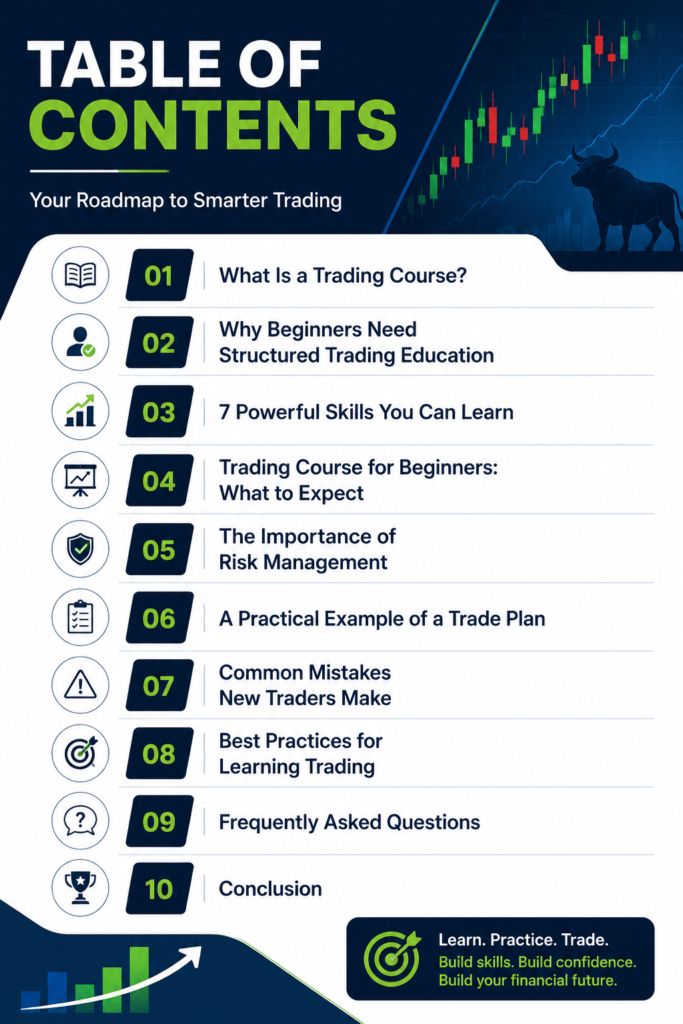
Table of Contents
- What is a Trading Course?
- Why Beginners need Structured Trading Education
- 7 Powerful Skills You Can Learn
- Trading Course for Beginners: What Should You Expect?
The Important for Risk Management
Common Mistake New Traders Make
Best Pratices for Learning Trading
Frequently Asked Question
Conclusion
What Is a Trading Course?
A Trading Course is an educational program designed to teach people how financial markets and trading processes work. Depending on the course, topics may include stocks, derivatives, technical analysis, market behaviour, chart reading, trading strategies, and risk management.
The quality of courses can vary significantly. A useful program should explain not only when a trader might enter a position, but also why that decision is being made and what could invalidate the idea.
Learning Theory Is Not Enough
For example, learning what a support level means is useful. However, practical learning involves studying how price behaves around that level in different market conditions.
A strong course usually combines:
- Market fundamentals
- Chart analysis
- Trading strategies
- Risk management principles
- Trade planning
- Practical examples
- Historical market analysis
- Paper trading or simulated practice
The real value comes from understanding how these elements work together.
To build a strong foundation, you can also explore our Trading Classes and Basic Share Market Course for additional learning resources and practical market knowledge.
Why Beginners Need Structured Trading Education
The financial market contains a huge amount of information. A beginner can easily become confused by indicators, strategies, news, and conflicting opinions.
Structured education helps create a logical learning path.
Structured trading education helps beginners understand market basics, trading strategies, and risk management in a step-by-step manner. It also reduces common mistakes and builds the confidence needed to make informed trading decisions.
For example, instead of immediately learning ten different indicators, a beginner might first understand market trends, support and resistance, price behaviour, and risk per trade. Once these foundations are clear, more advanced concepts become easier to understand.
A Trading Course for Beginners should therefore focus on building skills in the right sequence rather than overwhelming students with complex terminology.
Industry Insight
Experienced traders often spend more time managing risk than searching for the perfect entry. This is an important lesson for beginners. A successful looking strategy can still produce poor results if position sizes are too large or losses are allowed to grow without a predefined plan.
7 Powerful Skills You Can Learn in a Trading Course
1. Understanding Market Structure
Market structure helps traders identify whether prices are generally moving upward, downward, or sideways.
Instead of guessing where the market will go, traders learn to observe price behaviour and develop a structured view.
2. Reading Price Charts
Charts provide historical information about price movement. Learning how to read them can help traders identify important levels, trends, and possible areas of interest.
The goal is not to predict every movement perfectly. It is to make better informed decisions.
3. Technical Analysis
Technical analysis involves studying price, volume, patterns, and other market information.
A beginner should avoid using too many indicators at once. Understanding a few concepts properly is usually more useful than adding multiple tools without a clear reason.
4. Building a Trading Strategy
A strategy provides rules for decision making.
For example, a simple plan might define:
- Market conditions to trade
- Entry criteria
- Exit criteria
- Stop loss placement
- Profit target
- Maximum acceptable risk
Without clear rules, emotions can easily influence decisions.
5. Risk Management
Risk management is one of the most important topics in any Trading Course.
A trader may be correct about market direction but still face serious losses if too much capital is placed in one trade.
Position sizing and predefined risk limits can help prevent a single bad decision from causing disproportionate damage.
6. Trading Psychology
Fear, excitement, frustration, and overconfidence can influence trading behaviour.
For example, after several profitable trades, a beginner may suddenly increase position size. If the next trade fails, the loss may remove much of the earlier profit.
Learning to follow a process can be more valuable than reacting emotionally to every market movement.
7. Reviewing and Improving Trades
A trading journal allows traders to record:
- Why the trade was taken
- Entry and exit details
- Market conditions
- Risk involved
- Result of the trade
- Lessons learned
Over time, this information can reveal repeated mistakes and areas for improvement.
Trading Course for Beginners: What Should You Expect?
A beginner friendly course should start with the basics and gradually introduce practical concepts.
A reasonable learning journey may look like this:
- Understand how markets function.
- Learn basic chart concepts.
- Study trends and important price levels.
- Understand risk and position sizing.
- Learn a simple strategy.
- Practice using historical charts or simulation.
- Review results before considering real capital.
Mini Case Study
Imagine a student named Rahul who begins trading based on online tips. During his first month, he takes several random trades. Some generate profit, while others create losses.
After learning a structured approach, he starts recording every trade. He notices that most losses occur when he enters positions without waiting for his planned conditions.
The strategy itself may not have changed dramatically. His decision making did.
This demonstrates an important point: improvement often comes from consistency and review rather than constantly searching for a new strategy.
Why Risk Management Matters in a Trading Course
A good Trading Course should repeatedly explain that trading involves financial risk and profits cannot be guaranteed.
Consider two beginners with the same amount of capital.
The first person risks a large portion of capital on every trade. The second person uses a predefined risk limit and follows a position sizing plan.
Even if both experience losing trades, the second person may have a better opportunity to continue learning because losses are controlled.
A Simple Trade Planning Example
Before entering a trade, a trader might ask:
- What is the reason for this trade?
- Where will the idea be considered wrong?
- How much capital am I willing to risk?
- What conditions would justify exiting?
- Does this trade follow my written plan?
These questions can reduce impulsive decisions.
Common Mistakes New Traders Make
Following Tips Without Understanding Them
A trading idea should have a clear reason behind it. Blindly copying another person’s entry can create problems when market conditions change.
Ignoring Risk
Many beginners focus only on potential profit. Understanding potential loss is equally important.
Changing Strategies Too Quickly
A few losing trades do not automatically mean that a strategy is useless. Traders need enough properly recorded data to evaluate a method.
Overtrading
Taking more trades does not necessarily create better results. Quality and discipline matter.
Expecting Guaranteed Returns
No genuine educational process can guarantee trading profits. Markets are uncertain, and every strategy carries risk.
| Course Module | What You Learn | Practical Skills | Suitable For |
|---|---|---|---|
| Stock Market Basics | Shares, stock exchanges, indices, Demat accounts, and order types | Understanding how the stock market works | Complete beginners |
| Technical Analysis | Candlesticks, trends, support, resistance, indicators, and price action | Reading charts and identifying potential market setups | Beginner and intermediate learners |
| Trading Strategies | Intraday, swing, and positional trading concepts | Creating structured trading plans | Students and active learners |
| Risk Management | Position sizing, stop loss planning, risk and reward, and capital management | Managing potential losses before entering a trade | All trading learners |
| Trading Psychology | Discipline, patience, emotional control, and decision making | Building consistent trading habits | Beginners and active traders |
| Performance Review | Trading journals, mistake analysis, and strategy evaluation | Reviewing past decisions and improving the trading process | Intermediate and advanced learners |
Best Practices for Learning Trading
Here are some practical habits that can support your learning:
- Start with basic concepts before advanced strategies.
- Practice with historical charts and simulations.
- Focus on one or two setups initially.
- Maintain a detailed trading journal.
- Define risk before entering a position.
- Review both winning and losing trades.
- Avoid making decisions based purely on excitement or fear.
- Continue learning as market conditions change.
A Trading Course for Beginners is most useful when the student actively practices the concepts instead of simply watching lessons.
FAQ's
Find ansswers to commonly asked questions about our services and trading strategie
1. What is a Trading Course?
A Trading Course is an educational program that teaches concepts related to financial markets, chart analysis, trading strategies, risk management, and trade planning.
2. Is a Trading Course for Beginners useful?
Yes, a structured course can help beginners understand market concepts in a logical order. However, education does not guarantee trading profits.
3. How long does it take to learn trading?
The learning period depends on the person, available study time, market knowledge, and amount of practice. Building consistent decision making usually requires ongoing learning and review.
4. What is the most important skill in trading?
Risk management is one of the most important skills because even a good trading idea can result in losses if risk is not controlled properly.
5. Can I learn trading without investing real money immediately?
Yes. Beginners can first study concepts, analyse historical charts, and use paper trading or simulation before risking real capital.
Conclusion
A Trading Course can provide a useful foundation for anyone who wants to understand financial markets and develop practical trading skills. However, the real purpose of learning should be to build a disciplined process rather than chase quick profits.
Start with market basics, understand how to analyse price behaviour, learn to manage risk, and review your decisions regularly. Over time, practical experience and consistent study can help you develop a more informed approach.
The strongest learning process is usually simple: learn the concept, practice it, record your observations, identify mistakes, and improve gradually.