Advanced Trading: Practical Strategies for Smarter Market Decisions
Master Advanced Trading Strategies, Technical Analysis, Risk Management, and Market Psychology
Introduction
Once you understand basic trading concepts, the next challenge is learning how professional traders approach the market. Advanced trading is not simply about finding more indicators or placing more trades. It is about building a structured decision making process that combines market analysis, risk control, discipline, and patience.
For a young trader, this distinction matters. Markets can move quickly, and a single emotional decision can erase the results of several successful trades. Advanced skills are therefore less about predicting every price movement and more about managing uncertainty intelligently.
This guide explains the major concepts behind advanced trading, including technical analysis, trading strategies, risk management, market psychology, trade planning, and common mistakes.
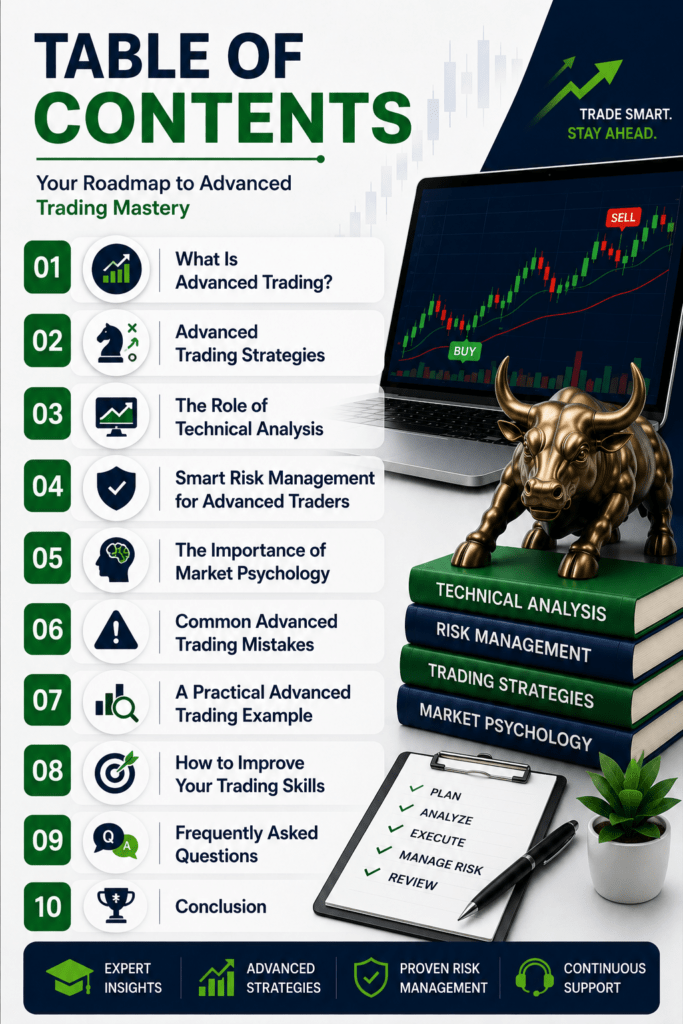
Table of Content
- What Is Advanced Trading?
- Advanced Trading Strategies
- The Role of Technical Analysis
- Smart Risk Management for Advanced Traders
- The Importance of Market Psychology
- Common Advanced Trading Mistakes
- A Practical Advanced Trading Example
- How to Improve Your Trading Skills
- Frequently Asked Questions
- Conclusion
What Is Advanced Trading?
Advanced trading refers to a more structured approach to participating in financial markets. Instead of relying on simple buy and sell signals, traders study several factors before entering a position.
These may include:
- Price structure
- Market trends
- Trading volume
- Volatility
- Support and resistance
- Momentum
- Risk to reward ratio
- Position sizing
- Market psychology
- Economic events
The objective is not to guarantee profitable trades. No legitimate trading method can do that.
Instead, the goal is to create a repeatable process where potential gains and possible losses are clearly understood before entering a trade.
Advanced Trading Strategies
There is no single strategy that works in every market condition. A strategy that performs well during a strong trend may behave very differently when the market moves sideways.
Trend Following
Trend following involves attempting to participate in an established market direction.
For example, if an asset is consistently creating higher highs and higher lows, a trader may look for opportunities to trade in the direction of that trend.
The important point is confirmation. A trader should not assume that every price increase represents a sustainable trend.
Breakout Trading
A breakout occurs when price moves beyond an important support or resistance area.
Imagine a stock repeatedly reaches a price level but fails to move above it. If price eventually breaks that level with strong volume, some traders may consider it a potential breakout setup.
However, false breakouts are common.
A disciplined trader considers what would prove the trade idea wrong before entering.
Swing Trading
Swing trading attempts to capture price movements over several days or weeks.
A swing trader may combine price structure, momentum, moving averages, volume, and technical analysis to identify potential entry and exit areas.
This approach can require less screen time than very short term trading, although it still involves meaningful risk.
Mean Reversion
Mean reversion is based on the idea that an asset that has moved unusually far from its recent average may eventually move back toward a more typical range.
This strategy can work differently depending on market conditions. A strong trend can remain extended much longer than a trader expects.
That is why strategy selection should always consider the broader market environment.
The Role of Technical Analysis
Technical analysis is one of the most commonly studied areas in advanced trading.
It involves examining historical price and volume information to identify patterns, trends, momentum, and possible trading levels.
Common tools include:
- Moving averages
- Relative Strength Index
- Bollinger Bands
- Volume analysis
- Candlestick patterns
- Support and resistance
- Trendlines
- Market structure
A common beginner mistake is adding too many indicators to one chart.
Five indicators showing similar information do not necessarily provide five independent reasons to enter a trade.
A cleaner approach is often better. For example, a trader might use market structure to identify the trend, volume to assess participation, and one momentum indicator as additional confirmation.
Technical analysis should support a trading plan rather than replace one
Risk Management in Advanced Trading
Risk management is arguably more important than finding an impressive entry signal.
A trader can have a strategy that works frequently and still lose money if the occasional losing trade is too large.
Position Sizing
Position sizing determines how much capital is allocated to a trade.
Suppose a trader has a trading account worth ₹100,000 and decides that a particular trade should expose only a small portion of the account to potential loss.
The trader can then calculate the position size based on the planned entry price and stop loss rather than choosing a position randomly.
This approach helps make risk measurable.
Risk to Reward Ratio
The risk to reward ratio compares the amount a trader is willing to lose with the potential gain being targeted.
For example, if a trader risks ₹1,000 while targeting ₹2,000, the potential reward is twice the planned risk.
However, a high ratio alone does not make a trade good. The probability of the setup working also matters.
Stop Loss
A stop loss can help define the point where a trading idea is no longer valid.
It should not be placed randomly just because a particular percentage sounds attractive.
The location should make sense in relation to the market structure and the original trading thesis.
Market Psychology
Trading decisions are heavily influenced by emotions.
Fear can make a trader exit a good position too early. Greed can encourage excessive position sizes. After a loss, frustration can lead to revenge trading.
This is why successful trading requires more than market knowledge.
One useful practice is keeping a trading journal.
After every trade, record:
- Why the trade was taken
- Entry price
- Planned exit
- Stop loss
- Position size
- Market conditions
- Actual result
- Emotional state
- What could be improved
After 30 or 50 trades, patterns may become visible.
Perhaps you perform well when following your plan but lose money after taking impulsive trades. That information is more valuable than simply looking at the total profit or loss.
- Advanced Trading mein experienced traders technical analysis aur market trends ka detailed analysis karte hain.
- Advanced Trading strategies ko samajhne ke liye price action aur chart patterns ki knowledge important hoti hai.
- A structured Advanced Trading Course traders ko complex market situations ko better understand karne mein help kar sakta hai.
- Advanced Trading mein risk management aur proper position sizing ko ignore nahi karna chahiye.
- Technical indicators ka practical use seekhna Advanced Trading skills ko improve karne mein helpful ho sakta hai.
- Advanced Trading Strategies ko apply karne se pehle traders ko market analysis aur trading psychology par focus karna chahiye.
- Consistent practice aur disciplined approach ke saath Advanced Trading concepts ko gradually develop kiya ja sakta hai.
How to Improve Your Trading Skills
Improvement comes from repetition and review, not from collecting endless strategies.
A practical learning process is:
- Learn one strategy properly.
- Understand the market conditions where it works.
- Backtest historical examples.
- Record the results.
- Paper trade the setup.
- Review your mistakes.
- Use small risk when moving toward live trading.
- Track performance over a meaningful sample.
- Refine the rules based on evidence.
- Avoid changing the system because of one bad trade.
You can also explore related resources on your website, including Basic Share Market Course to build knowledge progressively.
| Trading Class Level | Suitable For | Topics Covered | Practical Learning |
|---|---|---|---|
| Beginner Trading Classes | Students and complete beginners | Stock market basics, shares, charts, and order types | Basic chart reading and market observation |
| Technical Analysis Classes | Beginners with basic market knowledge | Candlesticks, trends, support, resistance, and indicators | Chart analysis and trade setup practice |
| Intraday Trading Classes | Active traders | Price action, volume, entry and exit planning | Intraday market analysis |
| Swing Trading Classes | Part time traders | Trend analysis, chart patterns, and risk management | Multi day trade planning |
| Options Trading Classes | Learners with market experience | Calls, puts, option strategies, and risk concepts | Options strategy analysis |
| Advanced Trading Classes | Experienced learners | Advanced strategies, trading psychology, and portfolio risk | Trade review and performance analysis |
Common Advanced Trading Mistakes
Using Too Much Leverage
Leverage can increase exposure without requiring the full position value as capital. It can also magnify losses.
Beginners moving into advanced products should understand leverage thoroughly before using it.
Overtrading
More trades do not automatically mean more opportunities.
Sometimes the best decision is to wait.
If a trader takes ten low quality trades instead of two well planned setups, additional activity can actually make performance worse.
Changing Strategies After a Few Losses
Every legitimate strategy will experience losing trades.
Changing your entire system after three or four losses can prevent you from learning whether the strategy actually works over a meaningful sample.
Ignoring Trading Costs
Brokerage, taxes, spreads, fees, and other costs can affect actual returns.
A strategy that looks profitable before costs may produce a very different result after all expenses are considered.
Practical Trading Example
Imagine a trader identifies an established upward trend in a stock.
The trader marks an important resistance level and waits rather than buying immediately.
Price eventually moves above the resistance area. Volume increases, supporting the idea that market participation has strengthened.
Before entering, the trader determines:
- Entry level
- Stop loss
- Position size
- Profit target
- Maximum acceptable loss
The trade later moves against the trader and reaches the planned stop loss.
The loss is disappointing, but it is controlled because the trader followed the original risk plan.
This is an important lesson in advanced trading.
A good trading decision can still produce a losing trade. The quality of the decision should be judged by the process, not only by the outcome.
FAQ's
Find ansswers to commonly asked questions about our services and trading strategie
What is advanced trading?
Advanced trading is a structured approach that combines market analysis, trading strategies, risk management, position sizing, and psychological discipline.
Is advanced trading suitable for beginners?
Beginners should normally understand basic market concepts before attempting advanced strategies. A strong foundation can make advanced topics easier to understand.
Why is technical analysis important in advanced trading?
Technical analysis can help traders study price behaviour, market structure, momentum, volume, and potential trading levels. It should be used as part of a broader trading process.
What is the most important part of advanced trading?
Risk management is one of the most important components because even a good strategy can experience losing trades.
How long does it take to learn advanced trading?
There is no fixed timeline. The learning process depends on your background, practice, market knowledge, strategy testing, and ability to review mistakes objectively.
Conclusion
Advanced trading is not about finding a secret indicator that predicts every market movement. It is about becoming more systematic.
Strong traders understand their setup, define risk before entering, study market conditions, manage their position size, and review their decisions honestly.
Technical analysis can help identify market behaviour, while risk management protects trading capital and psychology helps prevent emotional decisions.
If you want to progress beyond basic concepts, focus on developing one reliable process at a time. Learn it, test it, document the results, and improve it based on evidence.