Learning Algorithmic Trading: Build Smarter Automated Strategies
Learn Algorithmic Trading from Basics to Advanced Strategies, Automation, Backtesting, and Risk Management
Introduction
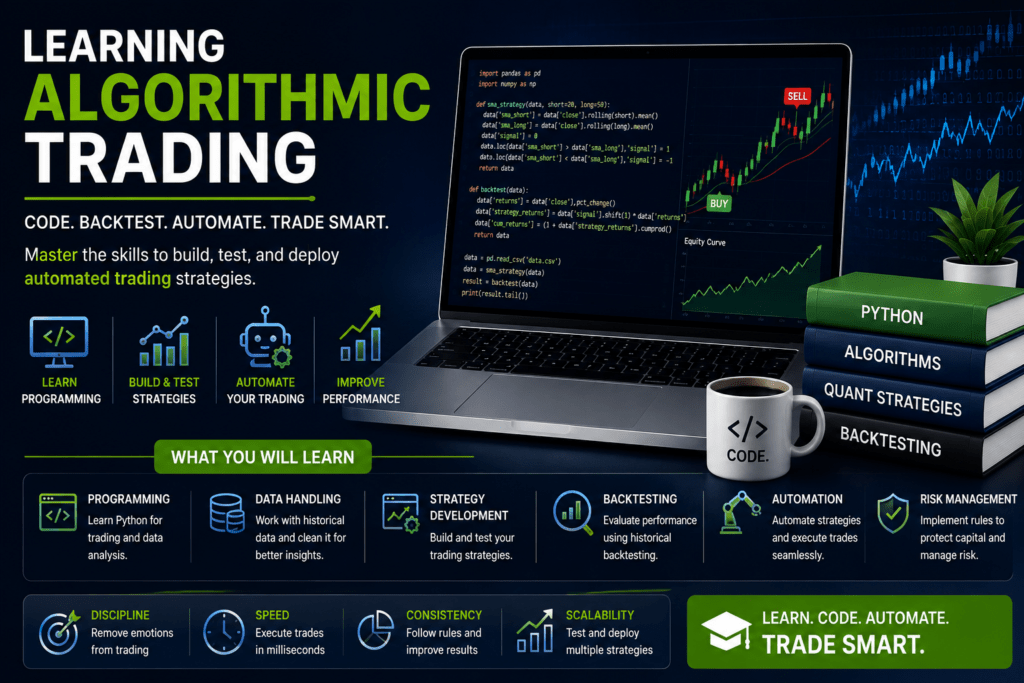
Learning algorithmic trading can seem intimidating when you first hear terms such as Python, backtesting, APIs, quantitative strategies, and automated execution. However, you do not need to be an expert programmer or mathematician to begin.
At its simplest, algorithmic trading means using clearly defined rules to analyse market data and make trading decisions with the help of a computer program. Instead of manually watching a chart and deciding when to enter or exit, you can create rules that a computer follows consistently.
For someone between 18 and 25, this field can be particularly interesting because it combines finance, programming, statistics, data analysis, and logical thinking. The important part is learning the foundations before attempting to automate real money decisions.
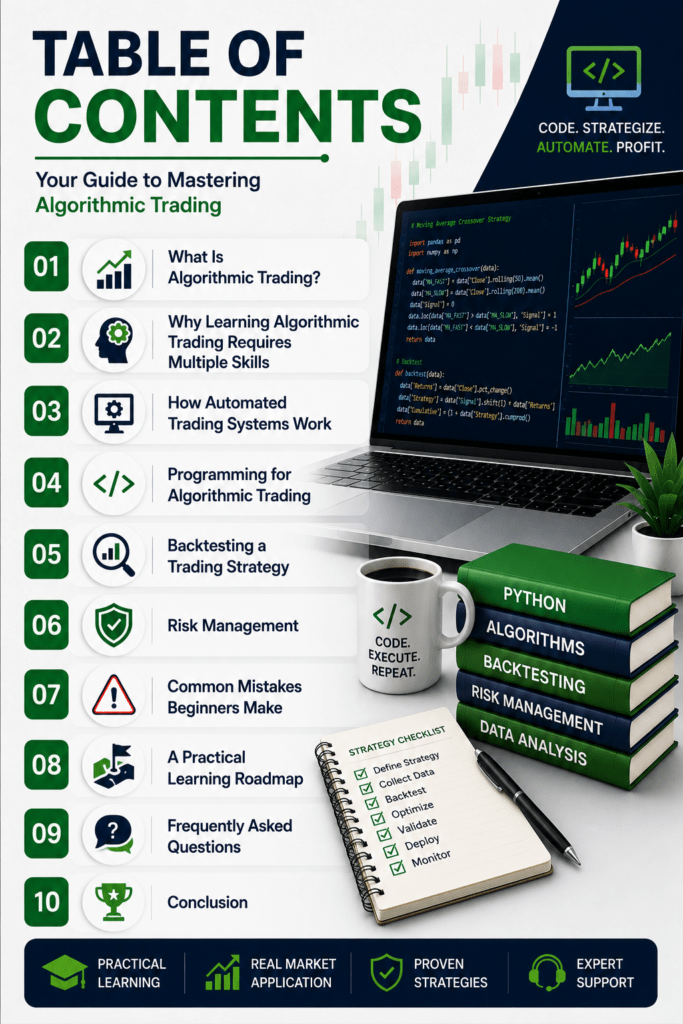
Table of Contents
- What Is Algorithmic Trading?
- Why Learning Algorithmic Trading Requires Multiple Skills
- How Automated Trading Systems Work
- Programming for Algorithmic Trading
- Backtesting a Trading Strategy
- Risk Management
- Common Mistakes Beginners Make
- A Practical Learning Roadmap
- Frequently Asked Questions
- Conclusion
What Is Algorithmic Trading?
Algorithmic trading uses computer programs to follow predefined rules for analysing markets and executing orders.
A simple strategy might say:
If a short term moving average crosses above a longer term moving average, consider an entry. If the price falls below a predefined risk level, exit the position.
A human trader can follow these rules manually. An algorithm can perform the same process automatically when the required market data becomes available.
This does not mean the algorithm knows what the market will do next. It simply follows the instructions it has been given.
That distinction is important. Automation can improve consistency, but it cannot turn a poor strategy into a profitable one.
- Learning algorithmic trading helps beginners understand how trading strategies can be built using rules and data.
- A structured approach to learning algorithmic trading makes it easier to understand market logic and automation.
Why Learning Algorithmic Trading Requires Multiple Skills
Learning algorithmic trading is not only about writing code.
You need to understand several connected areas.
Financial Markets
First, understand how the market itself works.
Learn about:
- Stocks
- Futures
- Options
- Market orders
- Limit orders
- Bid and ask prices
- Trading volume
- Volatility
- Liquidity
- Transaction costs
Without this foundation, it is easy to write a program that looks technically correct but behaves poorly in actual market conditions.
Programming
Python is a popular starting point because it has a large ecosystem for data analysis and quantitative work.
A beginner should understand:
- Variables
- Conditions
- Loops
- Functions
- Lists and dictionaries
- File handling
- Basic object oriented programming
- Data manipulation
Libraries such as pandas and NumPy can then make working with financial data considerably easier.
Statistics
Statistics becomes important when you start testing strategies.
You may need to understand:
- Average return
- Standard deviation
- Probability
- Correlation
- Maximum drawdown
- Win rate
- Risk to reward ratio
You do not need advanced mathematics on your first day. Build the concepts gradually and connect each one to a real trading problem.
How Automated Trading Systems Work
Automated trading systems generally follow a sequence.
First, the system receives market data.
Next, it processes that information according to predefined rules.
Then, it generates a trading signal.
Finally, depending on the system and broker connection, it may send an order for execution.
For example, imagine a strategy that checks the closing price of a stock every five minutes.
The algorithm could be instructed to:
- Download the latest data.
- Calculate two moving averages.
- Compare their values.
- Generate a signal if the conditions are satisfied.
- Check the risk rules.
- Send an order if all conditions are valid.
- Record the transaction.
This is the basic logic behind many automated trading systems.
Real systems can become much more complicated because they must also handle failed orders, missing data, market hours, network problems, position limits, and unexpected conditions.
- Before starting learning algorithmic trading, it is important to understand basic market concepts and trading strategies.
- Learning algorithmic trading also introduces you to strategy development, backtesting, and risk management.
Programming for Algorithmic Trading
A practical way to begin is to learn Python alongside market concepts rather than studying programming in isolation for months.
Start with a small project.
For example, create a program that loads historical stock prices and calculates a simple moving average.
Then expand it so that the program identifies when one moving average crosses another.
After that, add entry and exit rules.
Finally, calculate how the strategy would have performed historically.
This approach makes programming easier to understand because every coding concept has a practical purpose.
For official Python documentation, beginners can use the Python documentation. For data analysis, the pandas documentation is another useful reference.
- With consistent practice, learning algorithmic trading can help you understand how automated trading systems work.
- Beginners can make better decisions while learning algorithmic trading by testing ideas before using real capital.
Backtesting a Trading Strategy
Backtesting is one of the most important concepts in algorithmic trading.
It means applying a trading strategy to historical market data to see how the rules would have behaved in the past.
Suppose you create a strategy that buys when a particular moving average crosses above another and exits under a defined condition.
You could test those rules across several years of historical data.
The results might show:
- Number of trades
- Winning trades
- Losing trades
- Total return
- Maximum drawdown
- Average trade
- Transaction costs
However, backtesting has a major limitation.
A strategy that performed well historically is not guaranteed to perform well in the future.
Avoiding Overfitting
One common problem is overfitting.
Imagine you keep changing your strategy until it produces excellent historical results. You might accidentally create rules that fit old market data rather than rules that identify a genuine market behaviour.
A better approach is to separate data into different periods.
Use one period to develop the strategy and another period to test whether it continues to behave reasonably on unseen data.
This helps reduce the temptation to design a system specifically around historical results.
Risk Management in Algorithmic Trading
Automation does not remove financial risk.
In fact, automation can sometimes increase risk because a program may execute trades much faster than a human.
A responsible system should have clear risk controls.
These may include:
- Maximum position size
- Maximum daily loss
- Stop loss rules
- Maximum number of open positions
- Capital allocation limits
- Order validation
- Emergency shutdown conditions
For example, if a program suddenly generates hundreds of orders because of a coding error, a predefined safety limit could prevent the system from continuing indefinitely.
Risk controls should therefore be designed before connecting a strategy to real money.
For investor education and regulatory information in India, SEBI Investor provides official educational resources. The NSE also publishes information about market participation and investor awareness.
- Python and market data analysis are useful skills to develop when learning algorithmic trading.
- A practical learning algorithmic trading course should include coding, strategy testing, and performance analysis.
- Learning algorithmic trading requires patience, continuous practice, and a clear understanding of market risks.
| Course Module | What You Learn | Practical Skills | Suitable For |
|---|---|---|---|
| Introduction to Algorithmic Trading | Understand algorithmic trading, automated trading systems, trading algorithms, and rule-based strategies. | Understanding how automated trading strategies work. | Complete beginners |
| Python for Algorithmic Trading | Learn Python basics, data handling, financial data analysis, and programming concepts used in trading. | Working with market data and developing basic trading algorithms. | Beginners and aspiring algo traders |
| Market Data Analysis | Learn how to collect, organize, process, and analyze historical and real-time market data. | Analyzing price data and identifying useful market information. | Students and intermediate learners |
| Algorithmic Trading Strategies | Explore trend-following, momentum, mean reversion, breakout, and indicator-based trading strategies. | Creating structured and rule-based trading strategies. | Beginner and intermediate learners |
| Backtesting Strategies | Understand how to test trading strategies using historical market data and evaluate their performance. | Testing and analyzing strategies before live implementation. | All algorithmic trading learners |
| Risk Management | Learn position sizing, stop-loss rules, capital allocation, risk-reward analysis, and drawdown management. | Managing risk within an algorithmic trading system. | All trading learners |
| Strategy Optimization | Understand parameter optimization, performance evaluation, and the importance of avoiding overfitting. | Improving strategies using structured testing and analysis. | Intermediate and advanced learners |
| Trading Automation | Learn the fundamentals of automated order execution, trading APIs, and systematic trading workflows. | Understanding the process of automating trading strategies. | Intermediate and advanced learners |
| Paper Trading and Performance Review | Practice strategies in a simulated environment and evaluate trading performance. | Testing strategies and reviewing results before live trading. | All algorithmic trading learners |
Common Mistakes Beginners Make
Automating Too Early
Some beginners learn basic Python and immediately try to create a live trading bot.
That is risky.
First understand the market, then build the strategy, backtest it, paper trade it, and only then consider whether live deployment is appropriate.
Trusting Backtest Results Too Much
A backtest is evidence about how a strategy behaved under historical conditions. It is not proof of future profitability.
Ignoring Trading Costs
Brokerage, taxes, exchange charges, spreads, and slippage can significantly affect short term strategies.
A strategy that appears profitable before costs may become unattractive after realistic expenses.
Using Complex Strategies Without Understanding Them
Adding more indicators, machine learning models, or complicated formulas does not automatically make a strategy better.
A simple system that you understand can be more useful than a complicated system that you cannot explain.
A Practical Learning Roadmap
If you are starting from zero, follow a gradual process.
Step 1: Learn Market Basics
Understand stocks, exchanges, orders, trading sessions, volume, and risk.
Step 2: Learn Python
Focus on programming fundamentals before moving into financial libraries.
Step 3: Learn Data Analysis
Practise working with historical price data using Python.
Step 4: Build a Simple Strategy
Start with straightforward rules that you can explain clearly.
Step 5: Backtest
Measure performance using realistic assumptions about costs and execution.
Step 6: Paper Trade
Observe how the strategy behaves without immediately risking real capital.
Step 7: Improve Risk Controls
Add position sizing, loss limits, and emergency protections.
Step 8: Study More Advanced Methods
Once your foundation is strong, you can explore quantitative methods, portfolio strategies, statistical models, and machine learning.
You can also continue your broader trading education through resources such as Trading Classes, Advanced Trading, and Basic Share Market Course.
FAQ's
Find ansswers to commonly asked questions about our services and trading strategie
What is learning algorithmic trading?
Learning algorithmic trading means developing knowledge of financial markets, programming, data analysis, strategy development, backtesting, automated execution, and risk management.
Do I need programming knowledge to learn algorithmic trading?
Programming knowledge is very useful for building and testing automated strategies. Python is a practical language for beginners because of its extensive data analysis ecosystem.
Is Python good for algorithmic trading?
Yes. Python is widely used for financial data analysis, strategy research, backtesting, and developing trading tools.
What are automated trading systems?
Automated trading systems are computer based programs that follow predefined rules to analyse market information and potentially generate or execute trading orders.
How long does it take to learn algorithmic trading?
There is no fixed timeline. Someone with programming and finance experience may progress faster, while a complete beginner needs more time to build both skill sets.
Conclusion
Learning algorithmic trading is best approached as a combination of finance, programming, statistics, and disciplined experimentation.
The goal should not be to create a complicated trading bot as quickly as possible. Instead, learn how markets work, build simple rules, test them honestly, understand their weaknesses, and add automation only when you understand what the system is doing.
Automated trading systems can provide consistency and speed, but they still depend on the quality of their underlying strategy and risk controls.
If you build your skills step by step, algorithmic trading can become a valuable technical area to explore alongside traditional trading and investing.